Last Updated: November 24, 2026
Quick Summary
Demo video ads are short videos that show a product in use, proving what it does rather than describing it. They outperform static creative because motion answers the buyer's real question in the first three seconds, where attention is won or lost. Keep them to 15 to 30 seconds for paid social.
- Every demo ad must prove the product works, fits the buyer's life, and that acting now is safe.
- Write the on-screen text before the voice-over, because most viewers watch on mute.
- Test the hook first, holding the proof and call to action constant.
- One shoot day planned around three hooks and two calls to action can yield six testable cuts.
- Approval by committee is the most common cause of missed launch dates on demo ads.
Table of Contents
- Why Product Demo Video Ads Outperform Static Creative
- Product Demo Video Examples Worth Studying
- What a Product Demo Video Script Template Needs
- Choosing the Right Product Video Ad Length
- Product Demo Video Best Practices for Paid Social
- Adapting Demo Ads for Meta, Google and TikTok
- Localising Demo Ads for Slovenian and European Audiences
- Book a Free Creative and Store Audit
- Frequently Asked Questions
Why Product Demo Video Ads Outperform Static Creative
Product demo video ads are short videos that show a product in use, proving what it does rather than describing it. Motion answers the buyer's real question: does this thing work?
Static creative can show a product. It cannot show a result. A shopper scrolling a feed wants to see the product solving a problem before reading a line of copy.
What a demo ad actually has to prove
Every demo ad has to prove three things, fast:
- That the product works. Show the mechanism, the texture, the before-and-after.
- That it fits the buyer's life. Put it in a real kitchen, a real gym, a real desk.
- That acting now is safe. Close with a clear call to action and a reason to click.
Miss any one and the viewer scrolls. The format is unforgiving, and that is the point.
Product Demo Video Examples Worth Studying
The strongest product demo video examples share one habit: they cut everything that does not prove the product. No long brand intros. No founder monologue. Just the product, a problem, and a visible result.
High-performing demo ads share a skeleton: a hand enters frame, the product does something, the result is obvious without narration, then the offer appears. You can watch the static ads, AI video, UGC, landing pages and Shopify stores we made for DTC brands across Europe.
Formats that show up again and again
- Live-action demo: a real person using the product on camera, often in a home or studio setting. Strongest for physical goods where texture, scale, and motion matter.
- Screen recording: for apps and SaaS, showing the interface doing the work. Keep it to one task, not a tour.
- Animated explainer: for products whose value is invisible, like ingredients, mechanisms, or software logic.
We see the same mistake in most briefs: brands try to fit three formats into one ad. Pick one, execute it cleanly, and let the product carry the story.
What to actually study in a demo ad
When you review a demo ad that works, do not just note the product category. Note four things:
- The first frame. Is the result visible before any text? If yes, the hook is doing the work.
- The proof moment. Which single feature is demonstrated, and how long does it stay on screen?
- The mute test. Cover the sound. Does the ad still make sense from on-screen text alone?
- The handoff. Does the ad's promise match the landing page the click lands on?
In DTC demo ads, the best-performing cut is rarely the most polished one. It is the one where the product appears fastest and the benefit is labeled in plain language.
Filming demo ads in Ljubljana
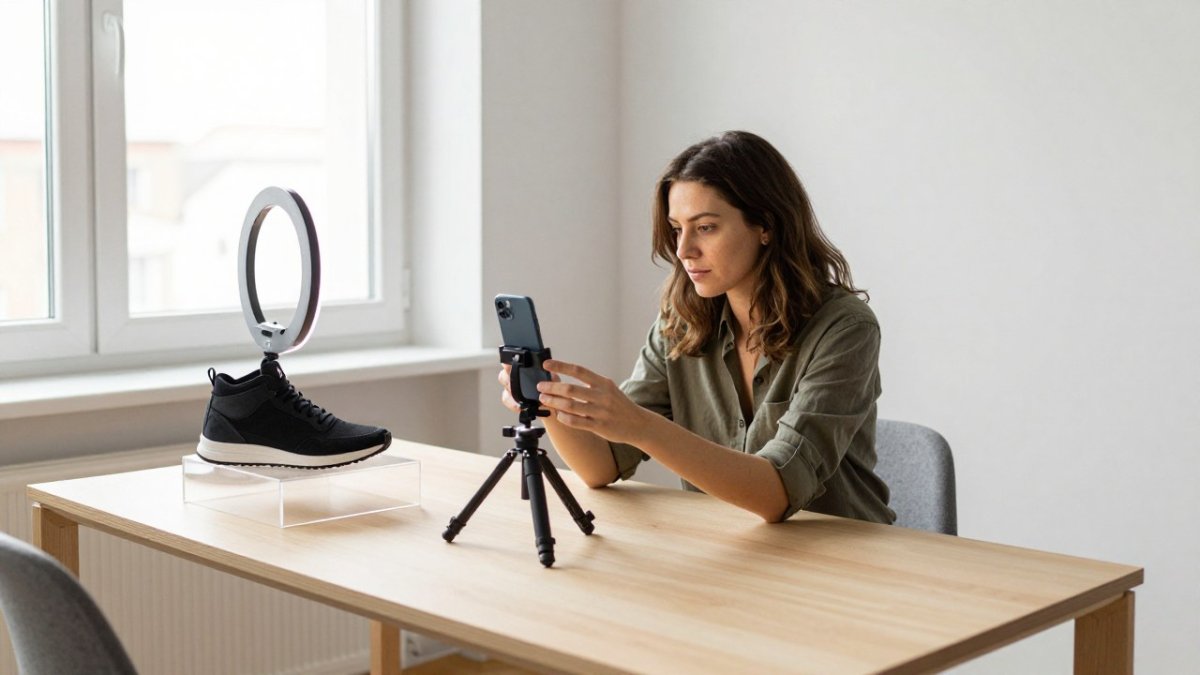
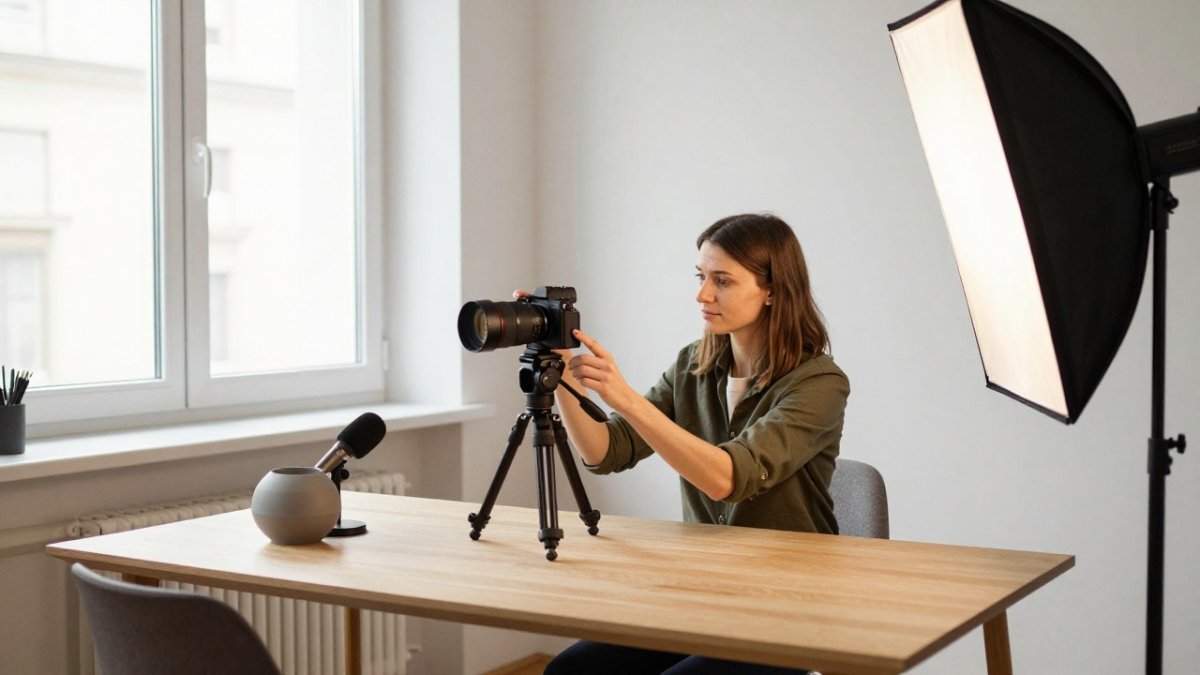
If you are producing demo ads in Slovenia, practical constraints shape the format more than the creative brief.
Keep the location secondary to the product; a demo shot in a generic bright studio often outperforms a scenic shoot where the product gets lost.
Watch out: booking a crew before the script and storyboard are locked is a common cause of reshoots.
From demo to ad: the adaptation step most examples skip
Most example roundups show the demo as a standalone video. In paid social, the demo is raw material. The same footage becomes a cold-traffic ad with a problem-first hook, a retargeting ad with an offer-first hook, and a creator-style cut with a first-person voice-over.
That is the angle worth studying: not the demo itself, but how many ad variants one demo shoot can produce. A single shoot day, planned around three hooks and two calls to action, can yield six testable cuts without additional filming.
What a Product Demo Video Script Template Needs
A product demo video script template is a short written structure that maps the first three seconds, the proof, and the call to action before anyone films. Without it, shoots drift and edits stall.
Here is the template we use with clients. Fill it in before production starts:
Hook (0-3s): [Show the problem or the result, no logo] Product entrance (3-6s): [Name the product on screen, show it in hand] Proof (6-15s): [Demonstrate the single most convincing feature] Benefit line (15-20s): [One sentence, on-screen text, plain language] Objection killer (20-25s): [Address the top hesitation: price, size, durability] Call to action (25-30s): [One action, one button, one offer]
Two rules make this template work. One feature per ad, not five. And write the on-screen text before you write the voice-over, because most viewers watch on mute.
Choosing the Right Product Video Ad Length
The right product video ad length is 15 to 30 seconds for paid social, and 30 to 60 seconds only when the product genuinely needs a demonstration to be understood. Longer is not more persuasive. It is more expensive and easier to skip.
Match length to platform and intent:
| Format | Ideal length | Best for | Watch out |
|---|---|---|---|
| UGC-style demo | 15-25s | Cold traffic, TikTok, Reels | Weak hook kills it in 2s |
| Live-action demo | 20-30s | Meta feed, retargeting | Slow product entrance |
| Screen recording | 30-45s | SaaS, app onboarding | Too many clicks shown |
| Animated explainer | 30-60s | Complex or invisible benefits | Generic motion graphics |
| Hybrid cut | 15-30s | Testing multiple angles | Mixed message |
Ideal length
For a deeper look at platform-specific runtimes, our breakdown of the best video ad length for TikTok covers what actually holds attention there.
Product Demo Video Best Practices for Paid Social
Paid social rewards demos that front-load proof. Put the result in the first frame, keep the product on screen, and design for sound-off viewing. Every second before the product appears is a second the viewer may leave.
What most guides miss is that the ad and the landing page are one unit. A demo ad that promises fast checkout fails if the store loads slowly on mobile.

Practical rules we apply on every paid social demo
- Hook in frame one. No logo, no intro, no fade.
- Show the product by second three. Hands, texture, real use.
- Caption everything. Most feeds play on mute.
A measurement framework for demo ads
Most demo ad advice stops at creative rules. The harder question is which numbers tell you whether the demo is working. A workable framework tracks five metrics in sequence, because each one answers a different question:
| Metric | What it tells you | When it fails |
|---|---|---|
| View-through rate | Whether the first frame stops the scroll | Hook is weak or product appears late |
| Watch time / average video duration | Whether the proof holds attention | Proof moment is buried or too long |
| Click-through rate | Whether the benefit line and CTA land | CTA is unclear or offer is weak |
| Conversion rate on the landing page | Whether the ad's promise matches the page | Handoff gap between ad and store |
| Cost per acquisition | Whether the whole unit is efficient | Any of the above, compounded |
Read the table top to bottom. If view-through rate is low, do not rewrite the whole ad; replace the first three seconds. If watch time is fine but click-through rate is low, the proof is working but the offer or CTA is not. If click-through rate is fine but conversion rate is low, the problem is usually the landing page, not the video.
Testing structure
Test one variable at a time, and test the hook first. Hold the proof and CTA constant while swapping three first frames against the same audience. Once a hook wins, test the benefit line.
Keep the sample honest. A demo ad that wins on a small budget over two days may not hold over a week. Hook tests need enough spend and time to exit the learning phase before the comparison is meaningful.
Production workflow and approvals
A demo ad that misses its launch date is usually a workflow problem, not a creative one. The end-to-end sequence that avoids it:
- Brief. One page: product, audience, single feature to prove, offer, platform, runtime.
- Script. Hook, product entrance, proof, benefit line, objection killer, CTA. Written before anything is filmed.
- Storyboard. Frame-by-frame sketch of the proof moment, so the shoot has a target.
- Filming or animation. Batch multiple hooks and CTAs into one session.
- First cut. Internal review against the brief, not against taste.
- Revisions. One consolidated round of feedback, not a drip of notes.
- Delivery formats. Vertical, square, and landscape exports; captioned and uncaptioned versions; correct lengths per platform.
- Launch and measurement. Set the metric sequence above before spend starts.
Watch out: approval by committee is the most common cause of missed launch dates on demo ads. Name one decision-maker and one revision round before production begins.
When you are ready to apply these to TikTok specifically, our TikTok Spark Ads setup guide walks through the campaign structure that keeps spend efficient.
Adapting Demo Ads for Meta, Google and TikTok
Each platform punishes a lazy repost. Meta favors native-feeling vertical video with a strong hook. TikTok rewards rougher, creator-led footage.
The fix is one shoot, many cuts. Film once in vertical, then export the ratios and lengths each platform requires. Keep the proof identical and change only the wrapper: captions, pacing, and call to action.
For Google specifically, the asset specs matter as much as the story. Our guide to Google Performance Max creative assets covers the image sizes, headlines and video specs that keep your demo looking right everywhere it runs.
Localising Demo Ads for Slovenian and European Audiences
A demo ad that converts in one market often fails in another, and the reason is rarely the product.
Keep the visual proof the same. Rebuild the text, the offer, and the checkout path for each market. Subtitles alone are not localisation.
Watch out: a translated ad that lands on an unlocalised store creates a trust gap the viewer feels immediately.
Book a Free Creative and Store Audit
If your demo ads perform but your store does not convert, the problem is rarely the video.
Our free audit reviews your creative and your store as one system.
About Conversion Design: a Shopify Plus agency and performance creative studio in Ljubljana, trusted by more than 200 DTC and ecommerce brands.
Most brands do not have a video problem or a store problem.
Frequently Asked Questions
How long should a product demo video ad be?
Most paid social demo ads work best between 15 and 30 seconds, with the product on screen and the core benefit clear within the first 3 seconds. Feed placements reward shorter cuts, while landing pages and sales enablement can carry a 60 to 90 second version. Produce one master edit and cut it down per placement rather than stretching a single runtime across every channel.
Can user-generated content work for product demo video ads?
Yes, when the creator actually demonstrates the product rather than just talking about it. A phone-shot clip of someone using the product, showing the result and naming one specific benefit often outperforms polished studio footage because it reads as proof. Pair UGC with a clean studio cut and test both against the same audience to see which holds watch time and click-through rate.
How should demo video ads be adapted for Meta, Google and TikTok?
Shoot vertical 9:16 for TikTok and Reels, keep 4:5 and 1:1 crops for Meta feed, and supply 16:9 for YouTube and Google. Keep text and product detail inside the safe zones, add captions because most viewers watch muted, and rewrite the hook per platform instead of reusing one opening. Each platform also rewards a different pace, so test separate edits rather than one file resized three ways.
What should a product demo video include?
A working demo ad shows the product in use, names one clear benefit, and ends with a single call to action. Include a hook in the first seconds, a real demonstration rather than a feature list, on-screen text for muted viewing, and a visual payoff showing the result. Skip long intros and brand logos at the start, since they cost you the viewers you paid to reach.