Table of Contents
- What Shopify Performance Creative Studio Services Actually Do
- Why Integration of Store Design and Ad Creative Matters
- How to Measure Creative Testing Results Across Your Store and Ads
- Shopify Conversion Rate Optimization Audit: Your Starting Point
- DTC Creative Strategy Best Practices for High-Converting Stores
- Service Offerings: What Your Studio Should Cover
- Evaluating and Choosing the Right Studio for Your Brand
- Frequently Asked Questions
Last Updated: October 4, 2026
What Shopify Performance Creative Studio Services Actually Do
A shopify performance creative studio bridges the gap between how your store looks and how your ads perform. Most brands treat these as separate problems: designers optimize the website, marketers create ads, and nobody talks. That disconnect costs money.
At Conversion Design, the best performing stores aren't just beautiful or fast, they're built around a single conversion thesis. Every element, from the hero image to the checkout flow, reinforces what the ad promised. That's what sets apart a studio approach from hiring a designer and a creative agency separately.
These services typically cover three core areas. First, custom store design and development that prioritizes conversion over aesthetics alone. Second, production and testing of ad creative that's optimized for your specific audience and platform. Third, the integration layer, ensuring your ERP, CRM, and payment systems work seamlessly so you can measure what actually drives revenue.
The ROI comes from eliminating friction. When your creative team and development team work in isolation, you end up with a beautiful store that doesn't convert, or high-performing ads that send traffic to a confusing checkout. A unified studio prevents that waste.
Why Integration of Store Design and Ad Creative Matters
The conventional wisdom says creative and development are different disciplines requiring different expertise. That's true. What's also true is that keeping them separate costs you conversions.
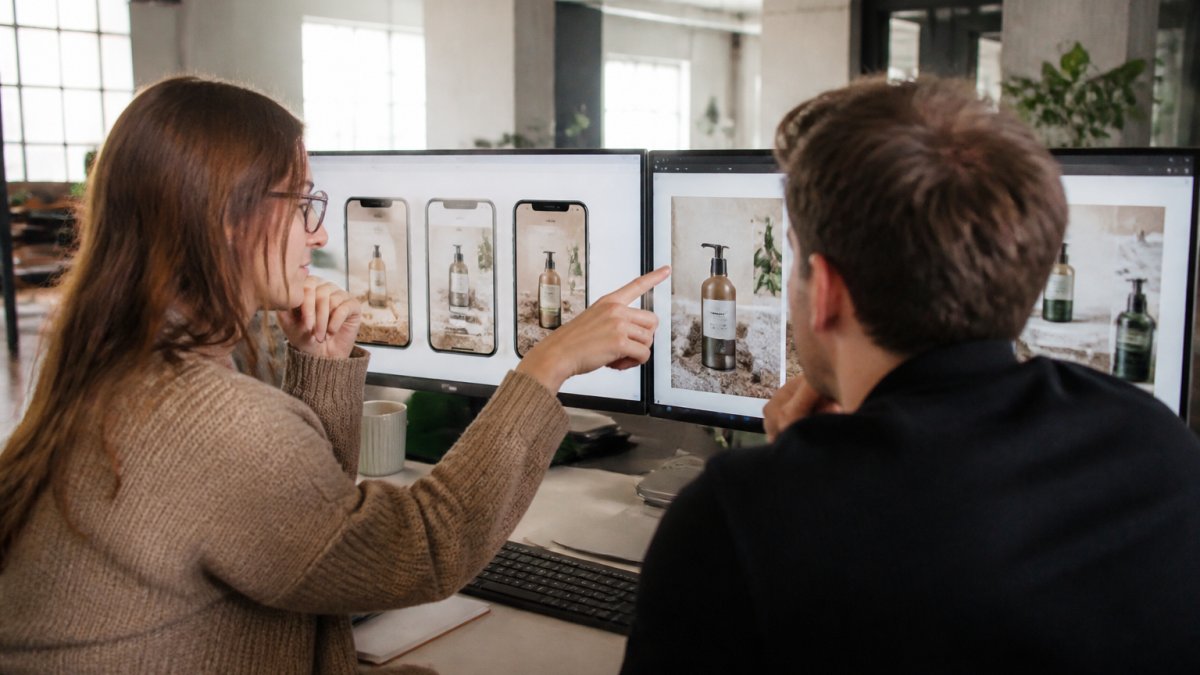
Here's what happens when they're siloed: your ads promise a specific value prop, say, "fastest shipping in the category", but your product pages bury shipping details below the fold.
When a single studio owns both, the creative informs the store design. If your ad emphasizes a specific product angle, that becomes the hero section. If your audience responds to social proof, testimonials get prominent placement.
This matters because conversion rate optimization without creative alignment is incomplete. You can speed up your checkout and reduce form fields, but if your ad creative isn't resonating with your audience, the store optimizations only matter at the margins.
The measurement challenge disappears too. When one team owns both store and creative, attribution becomes clear. You know whether a conversion lift came from a design change, a new creative asset, or better audience targeting.
How to Measure Creative Testing Results Across Your Store and Ads
Measuring creative performance requires tracking the same metrics across both channels, which most brands don't do well. You test an ad creative and measure click-through rate. You redesign a landing page and measure conversion rate. Neither tells you the full story.
Start with a single north-star metric: revenue per visitor. This forces you to measure the entire funnel, not just ad performance or store performance, but the combined effect.
Next, segment your tests by creative variable and store element. If you're testing a new product photo in ads, measure how that creative performs across different landing page layouts. If you're testing a new checkout flow, measure how it performs with your existing creative versus new creative.
Track these specific metrics:
- Cost per acquisition (CPA): What you spend to acquire one customer. This should improve as creative and store align better.
- Average order value (AOV): Whether your store design influences what customers buy. A better-organized product page can increase AOV.
- Return rate: Whether customers are satisfied with what they bought. Poor creative-to-reality alignment drives returns.
- Cart abandonment rate: Whether your checkout is the problem or your ads are sending the wrong audience.
The key is running tests long enough to reach statistical significance. A week of data is noise. Two weeks is better. A month is reliable. This matters because creative performance varies by day, by audience segment, and by external factors.
Most brands measure creative and store performance independently, then wonder why insights don't transfer. If you test a headline in ads and it wins by 15%, but your store doesn't use that messaging, you're leaving conversion on the table. A unified studio catches these gaps.
Shopify Conversion Rate Optimization Audit: Your Starting Point
Before you invest in new creative or redesign your store, you need a baseline. A conversion rate optimization audit identifies where you're losing visitors and revenue. It's the diagnostic that informs every decision that follows.
A proper CRO audit examines three layers. First, technical performance: page load speed, core web vitals, mobile responsiveness. A slow store loses visitors before they see your creative.
Most audits miss the creative-to-store alignment piece. You'll get recommendations to reduce form fields or improve page speed, which matter. But you won't get insight into whether your store experience reinforces what your ads promise.
Start by defining your current conversion rate and revenue per visitor. If you're not tracking these, you don't have a baseline. Then identify your highest-traffic pages and lowest-converting pages. The gap between them reveals opportunities.
Look at mobile separately from desktop. Many brands discover their mobile conversion rate is 40-60% lower than desktop, but they haven't diagnosed why. Is it slow load times? Confusing navigation?
Finally, map your customer journey from ad click to purchase. Where do visitors drop off? Is it the product page? The cart? The checkout? Each drop-off point has a different cause and solution.
DTC Creative Strategy Best Practices for High-Converting Stores
Direct-to-consumer brands live or die by creative performance. You can't rely on retail placement or brand recognition, you have to convince a stranger to buy in seconds.
High-converting DTC creative follows a few patterns. First, it leads with benefit, not feature. "Reduces wrinkles" beats "Contains retinol." Your audience doesn't care what's in the product; they care what it does for them.
Second, it uses real-world context. Lifestyle imagery that shows the product in use outperforms flat product shots. Your store should feature these images prominently.
Third, it tests relentlessly. DTC brands that win are the ones that run 10-20 creative variations per month, measure what works, and double down. Your store should support this velocity.
Fourth, it builds audience specificity into creative. A creative that works for new customers might not work for repeat customers. Your store can support this through segmentation, showing different messaging, offers, or product recommendations based on customer history.
Finally, it measures creative performance in the context of your store. A creative that drives high click-through rate but low conversion rate is expensive. A creative that drives lower click-through but higher conversion rate is efficient.
Service Offerings: What Your Studio Should Cover
When you're evaluating a studio, look for these core service areas. Not all studios offer all of them, and that's a signal about their approach.
Custom Shopify Store Design and Development
A proper Shopify store isn't a template with your colors applied. It's a custom build that reflects your brand and optimizes for conversion.
This includes custom theme development from scratch, not theme customization. A custom theme means your store can do things templates can't, conditional logic, dynamic content, advanced personalization. It also means you're not locked into a theme's limitations.
Responsive design is table stakes. Your store must perform on mobile, tablet, and desktop. But true responsive design goes beyond fitting content on small screens, it reorders elements for mobile context. What's important on desktop might be less important on mobile.
Performance optimization is critical. This requires image optimization, code minification, and smart caching.
Accessibility matters too, both for user experience and legal compliance.
Performance Creative Production and Testing
This is where the studio differentiates. It's not just creating ads, it's creating ads that drive store conversions.
This includes product photography and video that align with your store aesthetic. If your store uses lifestyle imagery, your ads should too. If your store emphasizes product detail shots, your ads should match.
Ad copy testing across platforms: what works on Instagram might not work on TikTok. A studio tests variations and identifies what resonates with your audience on each channel.
Landing page creative: many brands send ad traffic to their homepage. A better approach is custom landing pages that match the ad creative. This reduces cognitive load, the visitor sees the same message they clicked on.
Continuous iteration based on performance data. A studio doesn't create a campaign and launch it. It measures results, identifies what's working, and doubles down.
System Integration and Migration Services
When you're scaling, you need your Shopify store connected to your ERP, CRM, and payment systems. This isn't optional, it's how you measure ROI and operate efficiently.
This includes payment gateway integration: Stripe, PayPal, local payment methods. A studio ensures checkout is seamless and supports your customer base.
ERP integration: your inventory system needs to talk to your store. When you sell out, customers shouldn't be able to order.
CRM integration: customer data from your store should flow into your CRM so your marketing and support teams have context.
Zero-downtime migrations: if you're switching platforms or upgrading your store, migration should happen without downtime. A studio with migration expertise handles this.
Evaluating and Choosing the Right Studio for Your Brand
Not all studios are built the same. Some are design-focused. Some are development-focused. The best ones integrate both and add creative expertise.
Start by asking about their approach. Do they start with a CRO audit or jump straight to design?
Ask about their team structure. Do they have in-house developers, designers, and creatives? Or do they outsource parts?
Ask for case studies in your vertical. Ecommerce is broad, a studio that excels at fashion might not understand the nuances of supplements or beauty.
Ask about their process for measuring creative performance. How do they track whether a creative change actually moved the needle?
Ask about pricing and scope. Fixed scope and price is better than hourly billing or retainers with undefined deliverables.
Finally, ask about their post-launch process. Do they continue optimizing after launch, or do they hand off the project? The best studios treat launch as the beginning, not the end.
| Studio Type | Best For | Key Strength | Common Limitation |
|---|---|---|---|
| Design-focused | Brands prioritizing aesthetics | Visual excellence | May not optimize for conversion |
| Development-focused | Brands with complex integrations | Technical expertise | May lack creative strategy |
| Performance creative | DTC brands scaling ad spend | Unified creative-to-store approach | |
| Full-service agency | Brands needing everything | One point of contact | May lack specialization |
The real cost of misalignment between creative and store is invisible. You see lower conversion rates, higher customer acquisition costs, and slower growth.
Conversion Design specializes in closing that gap. Get started with a free audit to see where your biggest conversion opportunities are.
Frequently Asked Questions
What does a Shopify performance creative studio actually do?
A Shopify performance creative studio combines store design, development, and ad creative production under one team. This unified approach ensures your landing pages, checkout flow, and product pages align with your ad messaging, reducing friction in the conversion funnel. The studio handles everything from custom theme development and conversion rate optimization to performance creative testing, ensuring consistency across your storefront and paid campaigns.
How do you measure the success of creative testing results in Shopify?
Measure creative testing results by tracking metrics tied directly to business outcomes: conversion rate, average order value, cost per acquisition, and return on ad spend. Set up A/B testing within your Shopify store to compare landing page variants, checkout flows, and product page layouts. Use UTM parameters and pixel tracking to connect ad creative performance to downstream store behavior. Regular audits of these metrics reveal which creative directions and store experiences drive actual revenue, not just engagement.
Why is an integrated approach to store design and ad creative important?
An integrated approach prevents misalignment between what your ads promise and what your store delivers. When creative and development teams work separately, messaging inconsistencies, slow page load speeds, and friction in checkout can kill conversions despite strong ad performance. A unified studio ensures ad creative matches your store's brand identity, messaging aligns with landing page copy, and technical performance supports the user experience your ads set up, resulting in higher conversion rates and lower customer acquisition costs.
What should a DTC creative strategy include for best results?
A strong DTC creative strategy balances brand storytelling with performance metrics. Test multiple creative angles (lifestyle, benefit-driven, social proof, urgency) to identify what resonates with your audience. Align creative specs with your Shopify store's layout and mobile-first design to ensure consistency. Implement continuous A/B testing of ad creatives alongside store experience testing. Track which creative directions drive the highest-quality traffic to your store, then iterate based on conversion data rather than vanity metrics, ensuring every creative dollar directly supports store performance.